Chapter 3
Licensing and the national landlord register
What is a landlord register?
A national landlord register is a centralised, publicly accessible database that holds information about all landlords and their properties across the country. This information is uploaded by landlords themselves, who are required to pay a fee to register on the database. National landlord registers have been implemented in Wales, Scotland and Northern Ireland – but not in England.
Currently, councils in England have no comprehensive way of knowing which properties in their boroughs are privately rented and, therefore, which properties are illegally unlicensed in areas where licensing schemes operate. This is the main cause of the common complaint that criminal and rogue landlords simply don’t apply for licenses and that compliant landlords are unfairly burdened. This is not entirely fair, as there is evidence that licensing can enable councils to be more proactive in seeking out unlicensed and sub-standard properties, rather than relying on issues raised by tenants. Nevertheless, the lack of comprehensive data on which properties are being rented privately was a common issue cited by officers we interviewed.
Many different organisations – including local authorities, renters’ organisations, and landlord groups – have welcomed the idea of a national landlord register to boost standards in the PRS in England. A national register could collect information about all landlords, including their name and property address(es). Though ideally the register would be as public as possible, GDPR restrictions may prevent the publication of certain sensitive and personal details. Publicly available information on the register could therefore include landlords’ names and any relevant convictions against them, allowing renters to check that their landlord meets basic requirements to let out property. Local authorities could be granted access to more detailed and sensitive information that could help them enforce standards and take formal action against rogue landlords – for example, landlords’ home addresses, kept up to date by landlords themselves.
Proponents of a national landlord register argue that it could be implemented cheaply and efficiently, using the economies of scale created by operating on a national level.
Review of landlord registers in Wales, Scotland and Northern Ireland
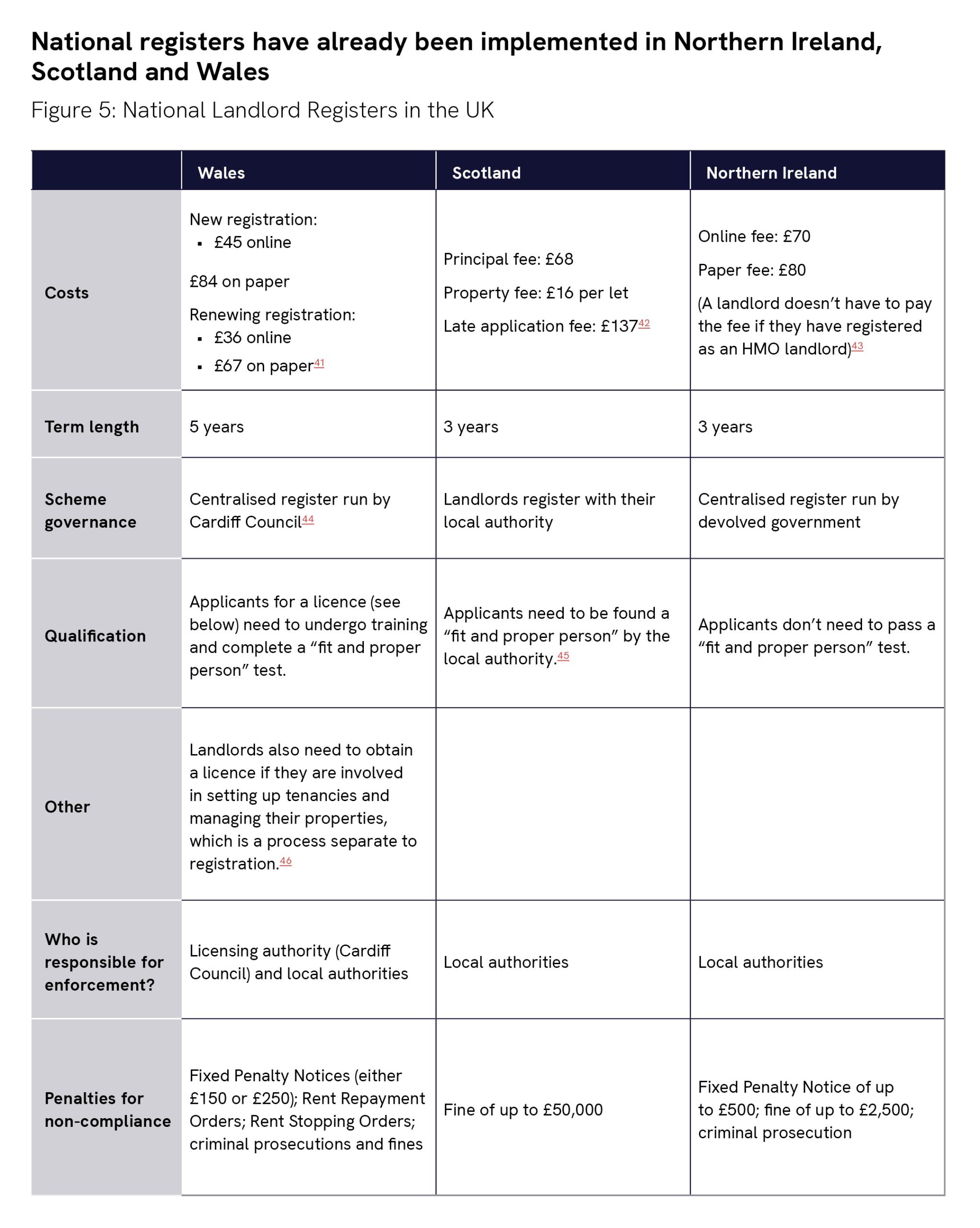
National registers have already been implemented in Northern Ireland, Scotland and Wales.
Case Study: Rent Smart Wales
Purpose of scheme
In 2014, The Housing Act (Wales) established mandatory landlord registration and licensing in Wales. 1 The scheme to deliver this, Rent Smart Wales (RSW), launched in November 2015. Cardiff Council was appointed as the licensing authority responsible for running the scheme 2
Eligibility
Rent Smart Wales requires all landlords and tenants to register their personal or business details and details of their property, at a cost to the landlord. This information is publicly accessible: potential tenants can check if a landlord has entered their details on the national register online or by telephone.
Landlords and letting agents also need to obtain a licence if they are involved in setting up tenancies and managing properties. Licences last five years: to obtain one, landlords must undergo training, which can be provided by RSW or an official training provider. Landlords also need to complete a “fit and proper person” declaration, declaring that they have no relevant convictions against them. 3.
Advantages and challenges
RSW officials have argued that the national register has provided a coordinated approach across Wales, helping bring consistency to PRS regulation throughout the rental market. 4As of November 2022, there are over 100,000 landlords who have registered their details on the platform, and over 200,000 properties registered. 5 With 69,935 courses undertaken, the landlord training has surpassed RSW’s targets. 6
A centralised register was seen as facilitating an easier service for those involved in property letting, as well as ensuring central coordination and enforcement capacity. 7 However, enforcement action is often taken with local authority partners, and Cardiff Council can rely on local authorities to undertake punitive measures against non-compliant landlords and letting agents. 6
Nonetheless, only one-third (37 per cent) of landlords surveyed by the National Residential Landlords Association in 2019 felt that RSW had improved the skills and knowledge of landlords in the sector – and only 14 per cent felt the initiative was being successful in rooting out rogue and criminal landlords. 6 Some local authorities have also reported that it is unclear whether it is the licensing authority (Cardiff Council) or individual local authorities that are responsible for taking the lead on enforcement. 10
Scottish Landlord Register
Mandatory landlord registration was introduced in Scotland in 2004 by the Antisocial Behaviour etc (Scotland) Act. 11 This requires all landlords to register their rental properties with each local authority in which they operate.
Eligibility
Before a landlord can register, they must be found to be a fit and proper person by the local authority.
Information requirements
When mandatory registration was first introduced, the information landlords needed to provide included their name, address, property address, and details of the letting agent managing the property. 12Since 2019, landlords have also had to declare that they are complying with certain duties, such as providing their tenant with a copy of the Energy Performance Certificate. 13
After they have registered, each landlord receives a Landlord Registration Number from the local authority which must be included in all their property advertisements. 14 The public can search the register to check that their landlord has a valid registration, find out who manages a property, and check which local authority a property is registered in.
Enforcement
The Scottish government states that “local authorities should develop a monitoring, compliance and enforcement policy to support effective administration of landlord registration and use of discretionary powers, ensuring that action is targeted where most needed.” 15 The sources available for local authorities to identify unregistered landlords include housing benefit claims, council tax registers, environmental health reports, and many others. 6
Local authorities also have the power to require people associated with a property – such as an agent – to provide information for the purpose of assisting them in carrying out their landlord registration functions. 6
Benefits and challenges
A review of the Scottish scheme in 2011 found that it had achieved some impact in raising standards in the private rented sector, with landlords demonstrating increased awareness of their obligations and improved compliance. 18 However, very few local authorities had robust processes in place to enforce landlord registration. Instead, there was a focus on encouraging registration and providing advice to landlords, rather than investigation or formal enforcement activity (such as court action or sanctions) for non-compliance. 6 Survey responses from local authorities indicated that this was often due to a lack of resources for enforcement activity. 6
The review found that the initial fees charged to landlords did not cover the costs of the scheme: this resulted in resources being focused on administration instead of landlord advice and enforcement. 6 It also found that there was no clear understanding of the total costs of administering and enforcing the scheme, meaning that these costs were not reflected in the fees charged to landlords. 6
Arguments for a national landlord register in England
A key benefit of the register is that it would allow renters to check whether their prospective or current landlords comply with the legal requirements on them. Renters would be empowered to make more informed decisions about whom they rent from, and could inquire about renting a property already knowing who owns it and whether they have obtained statutorily required safety documentation.
For local authorities, one of the main benefits of a national landlord register is that it would make it easier to identify landlords, thereby giving local authorities a better understanding of the PRS in their area. Local authorities we spoke to also argued that the information included on a mandatory register would significantly increase their ability to effectively enforce high standards in their housing market, allowing them to more easily track down landlords when issues arise, assuming landlords are required to keep their details up to date on the Portal. A national landlord register could also provide guidance on renting in the PRS and help increase awareness of landlords’ and tenants’ rights and responsibilities.
In a 2022 report, the not-for-profit consultancy Social Finance proposed that an effective national register should:
- Include a fit and proper person test.
- Be mandatory and publicly accessible.
- Include standardised and compulsory training for landlords.
- Be integrated with the national rogue landlord register.
- Integrate and record key property information.
- Link with a “property MOT”.
The UK government’s proposed Property Portal
In a White Paper entitled A Fairer Private Rented Sector (June 2022), the Department for Levelling Up, Housing and Communities proposes a “new digital Property Portal” on which all landlords would be required to register. Although we have few details around the Portal’s design at the time of writing, it appears to be a national landlord register in all but name.
The Property Portal will be designed to help tenants perform due diligence before signing rental contracts and enable landlords to check their compliance with existing regulations. The White Paper encouragingly promises to “future proof” the portal, making it capable of supporting future changes in policy – including the possibility of requiring minimum standards to be met by landlords and agents before properties can be let. This principle of adaptability is key to the portal’s success in the long term.
Should the Property Portal replace licensing?
Though the Property Portal and local authorities’ licensing schemes would complement each other, the portal could not replace licensing, as the two perform separate roles.
Licensing provides a regulatory framework which requires landlords, through the imposition of licence conditions, to proactively manage and maintain their rented homes – thus creating a set of standards and enforceable expectations. This means that renters are more likely to have a responsive and responsible landlord, and more likely to live in well-maintained, safe housing. In cases of alleged offences, the legal framework that licensing provides also allows local authorities to enter privately rented properties without notice and carry out inspections – leading to property improvements where necessary. This is beyond the scope of a national landlord register.
Licensing can also allow local authorities to increase their staff capacity, thereby enabling them to fulfil the aims and objectives of their licensing schemes (such as improvements in property conditions). Greater capacity within local authorities allows enforcement officers to undertake more inspections and resolve issues with tenants’ homes that might otherwise go unreported. In this way, where successful, licensing enables a proactive approach to PRS regulation – systematically building in a point of contact with local landlords while also creating a means of enforcing housing standards through compliance checks against licensing conditions. In contrast, the primary role of the Property Portal would be to collect data about all private landlords and their properties. This would allow renters to check that their landlord meets basic criteria to let property – informing their decisions about who to rent from – while also allowing local authorities to identify landlords in their area.
Some landlord membership organisations such as the National Residential Landlords Association (NRLA) have suggested that with the introduction of the Property Portal, local property licensing schemes would become obsolete. The NRLA has argued that, since a portal could theoretically collect all the information that is currently required to be submitted as part of licensing – including details about the landlord and their properties – further licensing schemes would be an “unnecessary duplication of effort” 23
However, registration on the portal would be a basic requirement for all rented property anywhere in England – it would not in itself prove to tenants and local authorities that a landlord is compliant with all regulations. Without the regulatory framework of licensing, or the information and resources it delivers, local authorities would be limited in their capacity to ascertain landlords’ compliance and enforce housing standards through proactive inspections and investigations. Therefore, without licensing, councils would only be able to undertake very limited and reactive work to improve properties in their local PRS, regardless of how much information the portal may provide. To improve standards in areas where a large PRS is causing problems for tenants and other residents, councils will continue to need the tools and resources licensing provides, even after the portal is in operation.
Moreover, the key aim of the Property Portal as currently designed is to collect basic data on all privately rented properties – not necessarily a comprehensive range of data at a detailed level. In contrast, licensing is rarely comprehensive in its coverage of properties across a borough, but it requires a relatively large amount of information from the landlords that are covered, which ensures that properties are safe and meet a set of standards. This includes (for example) copies of gas safety certificates, energy performance certificates (EPCs), and electrical installation condition reports.
This is not to say that the two tools are not complementary. If every landlord in the country were registered on the portal with their properties, local authorities would save an enormous amount of time searching for landlords’ identities, and could instead focus their resources on inspections and enforcement. Local authorities would also be able to impose more appropriate penalties on landlords who are not compliant with licensing regimes, which could be reflective of a larger portfolio identified through the portal. In cases of corporate ownership, company directors would be listed and would be responsible for updating their entries.
If combined at a national level with other datasets – such as tenancy deposit schemes data, council tax records or EPCs – the portal could be invaluable in identifying properties more at risk of non-compliance or in poor condition. This would in turn help local authorities to target their inspection and enforcement work.
The Property Portal could also provide information for landlords and enable a line of communication with local and central government, providing a “one-stop shop” for guidance and interaction. To help boost compliance, we recommend that the portal is hosted through One Login for Government (the government’s single-sign-on service) to reduce sign-up barriers for landlords.
Some local authorities have voiced concerns that even if the portal does not replace licensing, it could dilute it. They worry that central government may approve fewer local licensing schemes if it sees the Property Portal as sufficient for regulation of the PRS or might even move towards abolishing licensing altogether. However, as part of a unified enforcement approach, the division of labour between licensing and the register turns on balancing comprehensiveness with depth of data collection. Both are necessary for effective enforcement.
Our roundtables of local authorities revealed a preference for universal, mandatory licensing in addition to a landlord register as an option for long-term reform. Many argued that this would end the patchwork of standards enforced around the country and city. This inconsistency not only causes confusion and administrative work for landlords with properties across multiple boroughs; it also means that a universal set of standards for tenants cannot be guaranteed. We concluded that this was a long-term goal requiring significantly more capacity than currently exists in many councils, but that it would nonetheless resolve many existing issues with the selective licensing system, as outlined above.
Design principles for the Property Portal
In order for the Property Portal to act as a valuable resource for tenants and local authorities – and for it to complement selective licensing – we recommend the following design principles:
Data architecture: UPRNs
Central to avoiding duplication – where landlords have to provide the same information and documents to two different services, reducing likely compliance – is the creation of unique identification codes for each entry on the register.
Unique identification codes would provide an easy way for tenants to search for information about potential properties to ensure they are compliant. They would also allow local authorities to undertake efficient inspections and enforcement, and to share information with other local authorities. Unique identification codes could be mandatorily listed on rental adverts, as in Denver, USA (see details in Chapter 4 below). However, they could also serve a powerful role in strengthening both the portal and licensing schemes to improve standards in the PRS.
The Centre for Public Data suggests the use of Unique Property Reference Numbers (UPRNs) for each property, which are already used in the Energy Performance Certificate (EPC) database. 6 This would avoid the need for EPC certificates to be manually uploaded by landlords, and would strengthen future energy efficiency programmes targeted at the PRS.
Making full use of the data available will require licensed addresses in local authority databases to be linked to UPRNs, where they are not already. Through the Public Sector Geospatial Agreement with Ordinance Survey, local authorities are eligible for access to the AddressBase Plus database, which links UPRNs to addresses and postcodes. Linking the two may require some data cleaning by a council if it does not already use the Post Address File to perform automatic address lookups when landlords apply for licences.
This linkage would allow the rich data collected by many local authorities with licensing schemes to be automatically linked to the portal to auto-populate applications. If designed correctly, licensed landlords could avoid having to register manually, saving a substantial expense of time and money for council officers and, potentially, for applicants. Subject to data protection regulations, it could also significantly streamline the process of finding unlicensed properties within licensed areas, strengthening licensing programmes and allowing more resources to be directed toward inspections and enforcement.
Such a system could also allow councils to link the portal and their licensing databases to other useful datasets. This could enable projects like that run by Sheffield Council, which supported elderly residents living alone during the COVID-19 pandemic by linking UPRNs to council tax data to ensure accurate address matching. In the future, councils could link UPRN-tagged portal entries to many other public datasets on a range of topics including crime, anti-social behaviour and problem debt (subject to privacy safeguards). 25 Linked with council tax data, this could be an extremely powerful tool for discovering illegal letting and subletting, as well as their interaction with the short-term letting sector.
Open API
It is critical that access to the register be made as open as is practical. This is important both for tenants to be able to access information about their potential homes, and to enable digital integration of registration data. Creating an open API with unique identifiers for landlords would allow third parties – whether councils, charities or technology platforms – to link the register to their existing services. Existing services like the tenant review platform Marks out of Tenancy could use the register to automatically check whether reviewed properties are registered, and notify local authorities if they are not.
Transport for London’s free unified API has enabled a multitude of commercial and non-profit digital services to use travel data in the capital, with over 600 travel apps making use of the service. In 2017, it was estimated that TfL’s open data was generating up to £130m a year in economic benefits and savings. 26 Creating an open API for the Property Portal could enable many unforeseen innovations and partnerships. As recommended by the Centre for Public Data, this should be combined with the ability to download standardised, structured data from the register to promote innovative research on England’s PRS. 27
Resourcing and data ownership
Many of the local authority officers we interviewed expressed concern that they would be required to enforce the register in practice but would not be granted sufficient resources to do so, thereby adding further burdens to their under-staffed enforcement teams. Councils’ enforcement of the portal may include auditing certificates that landlords upload, or encouraging non-compliant landlords to register. The government may also ask local authorities to provide guidance to applicants. However, if they are to undertake such activity, local authorities must be granted sufficient funding to hire the staff to do so, whether this comes from registration fees or other sources. Local authorities should also have the flexibility to decide how to respond to non-registration: this would mean that they could issue warnings to late registrants, and choose between Civil Penalty Notices and prosecutions for serial offenders based on their capacity.
Some enforcement will necessarily take place without the involvement of local authorities. This is often referred to as “decentred regulation”, where individuals and campaign groups are able to enforce government regulations without the state engaging in enforcement or prosecution. An example in the PRS is Rent Repayment Orders (RROs), which allow tenants to reclaim up to 12 months of rent from landlords who have broken certain regulations, including licensing. 28 There is a strong case for councils to invest in communications with tenants about their rights to RROs, given their significant potential for deterring rogue landlords. There is a very strong argument for tenants to be able to claim for a rent repayment order in cases of persistent non-registration on the Portal.
Beyond tenants reclaiming their rent, mortgage providers could require buy-to-let landlords to be registered in order to be granted a mortgage or obtain refinancing – simultaneously improving compliance and enabling them to weed out potentially negligent or rogue landlords from their loan books. Mortgage providers could also be required to inform local authorities if they discover landlords who are not on the register.
Interactions with the short-term letting sector
Interviewees also expressed concerns that tighter regulation of the private rented sector could encourage landlords to shift their properties into the short-term letting sector through platforms like Airbnb. If true in practice, this would be a serious concern.
The high yields available from short-term lets have been widely remarked upon. 29 This incentive mismatch may be exacerbated by differences in taxation – the effects of the reversal of mortgage interest offsets for buy-to-let landlords have been widely noted in recent years. 6
Since 2015, landlords in London have been allowed to rent out their properties on a short-term basis for a maximum of 90 nights a year without applying for planning permission – the upper limit being intended to reduce the impact of this short-term let sector on the supply of long-term lets. However, we were repeatedly told that this limit has not been strictly enforced and that many properties are being let for more than 90 nights, due to the technical difficulty of proving non-compliance. Data from Inside Airbnb showed that at least 15 per cent of whole-property listings in London in 2022 were available for more than 90 nights, rising to 20 per cent in Westminster. 31 In Scotland, to ensure greater regulation of the sector, the Scottish government has moved towards a local-authority-run licensing regime for short-term lets, but as yet there has been no analysis of its effects.
In December 2022, the Prime Minister committed to plans for a new “tourist accommodation registration scheme”, and for consultation on requiring planning permission for new short-term holiday lets. This comes after recommendations from analysts in Manchester, who have called for a mandatory registration scheme that would require a permit for entire-home listings and give local authorities the power to refuse permits in “Short Term Let Control Areas” they would define. 32 We recommend that the Property Portal be designed for compatibility with any future short-term let register, so that the transfer of homes between the two sectors can be tracked.
Managing agents
Many rental properties are managed by a letting agent. This can occur in cases where landlords live abroad, are too busy, or perceive themselves to be underqualified to manage a property. In 2021 just over half of landlords used a letting agent, and just under one-fifth used an agent for management services – though the balance between landlord and agent in management responsibilities sometimes varies depending on the specific arrangements procured. 33
Landlords should always be listed on the portal, given that they own the property and receive rent. However, managing agents are often the most relevant party to receive important information or requests for action from tenants, councils or central government. A landlord living abroad with no involvement in running the tenancy may not always be as responsive or informative as the agent managing the property, and would be unable to carry out any required housing enforcement work. It would, therefore, be reasonable for the up-to-date details of managing agents to be listed on the portal alongside landlords, where applicable.